Technical guidance

Cumulative Impact Assessment

The EPA recognises that with increasing pressure from development on parts of WA’s unique environment, as well as other pressures such as climate change, it is imperative to strengthen CIA as a process. Reflecting this, cumulative impacts was added to the definitions provided in section 3(1)(b) of the EP Act as part of amendments made to the EP Act in 2020. This makes it explicit that the EPA’s consideration of impacts on the environment must include cumulative impacts.

The purpose of this guideline is to provide an overview of what cumulative impact assessment (CIA) is and how it is undertaken as a part of environmental impact assessment (EIA) under Part IV of the Environmental Protection Act 1986 (EP Act) in Western Australia (WA). It provides the basis for a consistent approach to CIA to be applied by proponents, across the majority of environmental factors and across the different regions of WA.

This guideline is intended to clarify the EPA’s expectations of proponents for CIA and aims to improve information quality on cumulative impacts, supporting informed decision-making and improved environmental outcomes.

Published Date
Guidelines and procedures

Aboriginal cultural heritage in EIA

The EPA acknowledges the repealed Aboriginal Cultural Heritage Act 2021 and has adjusted its Environmental Factor Guideline - Social Surroundings and related Technical Guidance to reflect the role of the amended and restored Aboriginal Heritage Act 1972.

The Technical Guidance provides additional information on procedures and the EPA’s environmental impact assessment process for Social Surroundings under the Environmental Protection Act 1986. This has been updated to support the latest changes made to the EFG and to ensure alignment with the restored AH Act 1972.

Published Date
Guidelines and procedures

Technical Guidance - Terrestrial vertebrate fauna surveys for environmental impact assessment

The content of this Guidance has been updated to reflect the EPA’s framework for environmental considerations in environmental impact assessment.

This guidance replaces two former Technical Guidance documents: ‘Technical Guidance – Sampling methods for terrestrial vertebrate fauna’ and ‘Technical Guidance – Terrestrial fauna surveys’.

The purpose of this technical guidance is to ensure that terrestrial vertebrate fauna data of an appropriate standard are obtained and used for environmental impact assessment. This guidance is applicable to terrestrial vertebrate fauna only and should be applied in conjunction with the EPA’s Environmental Factor Guideline: Terrestrial Fauna.

The Technical Guidance provides advice on:

  • desktop studies;
  • survey preparation and determining survey type and design;
  • habitat assessment, survey techniques and specimen handling; and
  • data analysis, mapping and reporting.

History of EPA guidance for terrestrial vertebrate fauna surveys

History of EPA guidance for terrestrial vertebrate fauna surveys


Published Date
Guidelines and procedures

Technical Guidance - Protecting the Quality of Western Australia’s Marine Environment

The purpose of this technical guidance is to:

  • assist proponents to design fit-for-purpose modelling and monitoring programs to spatially define, assess and manage potential impacts of their proposal on marine environmental quality, and
  • ensure proposals that have the potential to significantly affect marine environmental quality are described and assessed in a sound and consistent manner that demonstrates how the EPA’s objective for the Factor ‘marine environmental quality’ will be met.

The approaches outlined in this Guidance are not new. They have been applied to all significant and relevant proposals subject to formal environmental impact assessment for over a decade. This Guidance sets out the approach that has been refined and consolidated over this period in a single coherent document.

This document sets out the context for the guidance, describes the structure of the environmental quality management framework and how it is to be applied through environmental impact assessment to maintain a high level of quality in Western Australia’s marine waters. WA marine waters extend from the outer boundary of the State’s Coastal Waters through estuaries and inland to the limit of tidal influence where salinity is influenced by seawater, including marinas and canals that are contiguous with the marine environment. Although tailored to marine waters, the general approach is applicable to other estuaries and inland waters, but there are likely to be a different set of pressures and issues to be considered.

Published Date
Guidelines and procedures

Technical Guidance - Protection of Benthic Communities and Habitats

The EPA’s objective for the Factor Benthic Communities and Habitats is “to protect benthic communities and habitats so that biological diversity and ecological integrity are maintained”. The purpose of this Guidance is to explain how impacts on benthic communities and habitats (BCH) are considered during Environmental Impact Assessment (EIA) and to set out the type and form of the information that should be presented to facilitate the assessment of impacts on BCH in Western Australia’s marine environment.

This Guidance supersedes Environmental Assessment Guideline No.3 (EPA 2009), which mainly focused on protection of the primary producer component of BCH, and sets out:

  • the EPA’s contemporary approach for considering activities which may directly or indirectly cause impact or serious damage to, or irreversible loss of, benthic communities and habitats;
  • considerations for impact mitigation and how they should be applied;
  • a framework for considering cumulative loss of benthic communities and habitats and the potential consequences for marine ecological integrity and biological diversity;
  • the EPA’s expectations for information to be supplied by proponents for EIA; and
  • the boundaries of a local assessment unit for the Port of Port Hedland that replaces Environmental Protection Bulletin 14 (EPA 2011) and is to be used when assessing benthic impacts and cumulative losses of benthic communities and habitats in the area.

The geographic scope of this Guidance includes all Coastal Waters of Western Australia to the high water mark of the intertidal zone associated with the continental mainland and offshore islands.

Published Date
Guidelines and procedures

Technical Guidance - Sampling of short range endemic invertebrate fauna

The content of this guidance has not yet been updated to reflect the EPA’s framework for environmental considerations in environmental impact assessment.

This Guidance provides information on the standards and methods of survey required to assist in collecting the appropriate data on SREs for environmental impact assessment.

The content is the same as Guidance Statement No. 20 – Sampling of short range endemic invertebrate fauna for environmental impact assessment in Western Australia.

Published Date
Guidelines and procedures

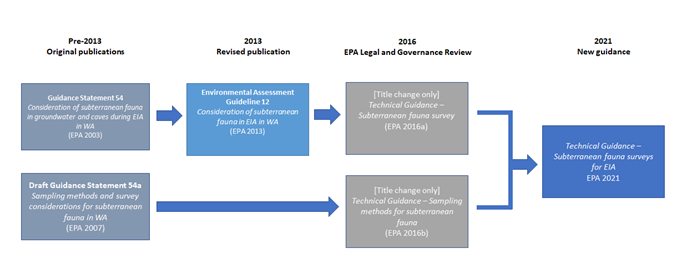
Technical Guidance - Subterranean fauna surveys for environmental impact assessment

The content of this Guidance has been updated to reflect the EPA’s framework for environmental considerations in environmental impact assessment.

This guidance replaces two former Technical Guidance documents: ‘Technical Guidance – Subterranean fauna surveys’ and ‘Technical Guidance – Sampling methods for subterranean fauna’.

This guidance is applicable to subterranean fauna only and should be applied in conjunction with the EPA’s Environmental Factor Guideline: Subterranean Fauna.

This document has been developed to provide guidance on the relevant impact assessment methods where subterranean fauna is likely to be a factor, particularly the standards of survey and type of information required to understand impacts. The purpose of this technical guidance is to ensure that subterranean fauna data of an appropriate standard are obtained and used for environmental impact assessment.

The Technical Guidance provides advice on:

  • desktop studies;
  • survey preparation and determining survey type and design;
  • habitat assessment, survey techniques and specimen handling; and
  • data analysis, mapping and reporting.

Background information can be located in the EPA’s Discussion Paper - A review of subterranean fauna assessment in Western Australia (EPA 2021), which is retained for reference only.

Published Date
Guidelines and procedures

Technical guidance - Environmental Impact Assessment of Marine Dredging Proposals

This Technical guidance describes the impact prediction and assessment framework that the EPA expects proponents and consultants to use so that predictions of the extent, severity and duration of impacts to benthic habitats associated with significant dredging activities are presented in a clear and consistent manner.

This is generic guidance that applies State-wide and as such, it does not differentiate between types of dredging proposals or regional environmental differences. Applying the framework across different projects provides a common approach to setting environmental outcomes and for monitoring impacts, which could improve understanding and prediction of dredging related environmental effects.

This version of the Technical guidance was published in October 2021. The framework remains largely unchanged, however the Guidance now incorporates the relevant scientific findings from the Western Australian Marine Science Institution’s Dredging Science Node. The information generated by the research has been collated and reviewed to identify and further refine the key findings, with input from relevant stakeholders. The bulk of the additional information is detailed technical advice most relevant to tropical north-west Western Australia and provided in three appendices. These appendices include suggested guideline values based on the tolerance of key biota to dredging pressures, the scientific rationale behind the values, advice relating to the pre-development baseline surveys required to support impact prediction and advice to assist proponents with post-approval monitoring and management programs.

It should be noted that while the framework outlined in this technical guidance is focussed on the Environmental Impact Assessment (EIA) of dredging-related activities, the approach can also be applied to the EIA of other types of development proposals to address uncertainty around impact predictions.

Published Date
Guidelines and procedures

Technical Guidance - Flora and Vegetation Surveys for Environmental Impact Assessment

The purpose of this technical guidance is to ensure adequate flora and vegetation data of an appropriate standard are obtained and used in environmental impact assessment (EIA). The technical information provided within this guidance is applicable to flora and vegetation only and should be applied in conjunction with the Environmental Protection Authority’s (EPA) policy for the Flora and Vegetation Factor.

This guidance should be applied when planning and undertaking flora and vegetation surveys for environmental impact assessment of significant proposals under Part IV of the Environmental Protection Act 1986 (EP Act).

This guidance provides advice on:

  • survey preparation and desktop study;
  • determining the type of survey required;
  • sampling techniques and survey design; and
  • data analysis and reporting.
Published Date
Guidelines and procedures
Get notified of updates and new content

Login to Subscribe to this page | Subscription Info

Printer Friendly, PDF & Email
