
Land

Technical Guidance - Terrestrial vertebrate fauna surveys for environmental impact assessment

The content of this Guidance has been updated to reflect the EPA’s framework for environmental considerations in environmental impact assessment.

This guidance replaces two former Technical Guidance documents: ‘Technical Guidance – Sampling methods for terrestrial vertebrate fauna’ and ‘Technical Guidance – Terrestrial fauna surveys’.

The purpose of this technical guidance is to ensure that terrestrial vertebrate fauna data of an appropriate standard are obtained and used for environmental impact assessment. This guidance is applicable to terrestrial vertebrate fauna only and should be applied in conjunction with the EPA’s Environmental Factor Guideline: Terrestrial Fauna.

The Technical Guidance provides advice on:

  • desktop studies;
  • survey preparation and determining survey type and design;
  • habitat assessment, survey techniques and specimen handling; and
  • data analysis, mapping and reporting.

History of EPA guidance for terrestrial vertebrate fauna surveys
History of EPA guidance for terrestrial vertebrate fauna surveys



Published Date
Guidelines and procedures

Statement of environmental principles, factors, objectives and aims of EIA

The purpose of this Statement is to communicate how, for the purposes of environmental impact assessment, the Environmental Protection Authority (EPA)

  • considers the object and principles of the Environmental Protection Act 1986 (the Act)
  • provide the aims of EIA
  • uses environmental factors and objectives to guide EIA
  • considers significance throughout the EIA process
  • takes a holistic view of the environment and a proposal potential impact on the environment
  • considers cumulative effects when assessing a proposal potential impact on the environment.
  • provide detail on the mitigation hierarchy

In the current version (Version 5.0), the Statement has been updated to reflect the revised Greenhouse Gas Emissions factor objective.

Published Date
Revised Date
Guidelines and procedures

Technical Guidance - Sampling of short range endemic invertebrate fauna

The content of this guidance has not yet been updated to reflect the EPA’s framework for environmental considerations in environmental impact assessment.

This Guidance provides information on the standards and methods of survey required to assist in collecting the appropriate data on SREs for environmental impact assessment.

The content is the same as Guidance Statement No. 20 – Sampling of short range endemic invertebrate fauna for environmental impact assessment in Western Australia.

Published Date
Guidelines and procedures

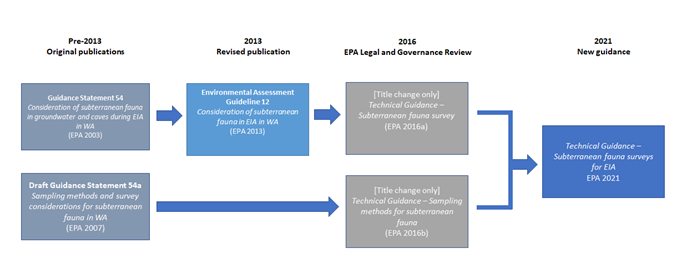
Technical Guidance - Subterranean fauna surveys for environmental impact assessment

The content of this Guidance has been updated to reflect the EPA’s framework for environmental considerations in environmental impact assessment.

This guidance replaces two former Technical Guidance documents: ‘Technical Guidance – Subterranean fauna surveys’ and ‘Technical Guidance – Sampling methods for subterranean fauna’.

This guidance is applicable to subterranean fauna only and should be applied in conjunction with the EPA’s Environmental Factor Guideline: Subterranean Fauna.

This document has been developed to provide guidance on the relevant impact assessment methods where subterranean fauna is likely to be a factor, particularly the standards of survey and type of information required to understand impacts. The purpose of this technical guidance is to ensure that subterranean fauna data of an appropriate standard are obtained and used for environmental impact assessment.

The Technical Guidance provides advice on:

  • desktop studies;
  • survey preparation and determining survey type and design;
  • habitat assessment, survey techniques and specimen handling; and
  • data analysis, mapping and reporting.

Background information can be located in the EPA’s Discussion Paper - A review of subterranean fauna assessment in Western Australia (EPA 2021), which is retained for reference only.

Published Date
Guidelines and procedures

Technical Guidance - Flora and Vegetation Surveys for Environmental Impact Assessment

The purpose of this technical guidance is to ensure adequate flora and vegetation data of an appropriate standard are obtained and used in environmental impact assessment (EIA). The technical information provided within this guidance is applicable to flora and vegetation only and should be applied in conjunction with the Environmental Protection Authority’s (EPA) policy for the Flora and Vegetation Factor.

This guidance should be applied when planning and undertaking flora and vegetation surveys for environmental impact assessment of significant proposals under Part IV of the Environmental Protection Act 1986 (EP Act).

This guidance provides advice on:

  • survey preparation and desktop study;
  • determining the type of survey required;
  • sampling techniques and survey design; and
  • data analysis and reporting.
Published Date
Guidelines and procedures

LAND

Factor guidelines and technical guidance: Land

Western Australia covers one third of the Australian continent, and includes eight of Australia’s fifteen biodiversity hotspots. The landscape ranges from the rugged Kimberley gorges in the tropical north, to the towering Karri forests in the cooler, wetter southwest and the spinifex and mulga of the arid interior.

The EPA considers the key ‘Land’ factors of flora and vegetation, landforms, subterranean fauna, terrestrial environmental quality and terrestrial fauna in its assessment of significant projects.

Get notified of updates and new content

Login to Subscribe to this page | Subscription Info

Printer Friendly, PDF & Email